
Artist spotlight: Leo Vargo and the Evolution of Glitch Realism
1 day ago
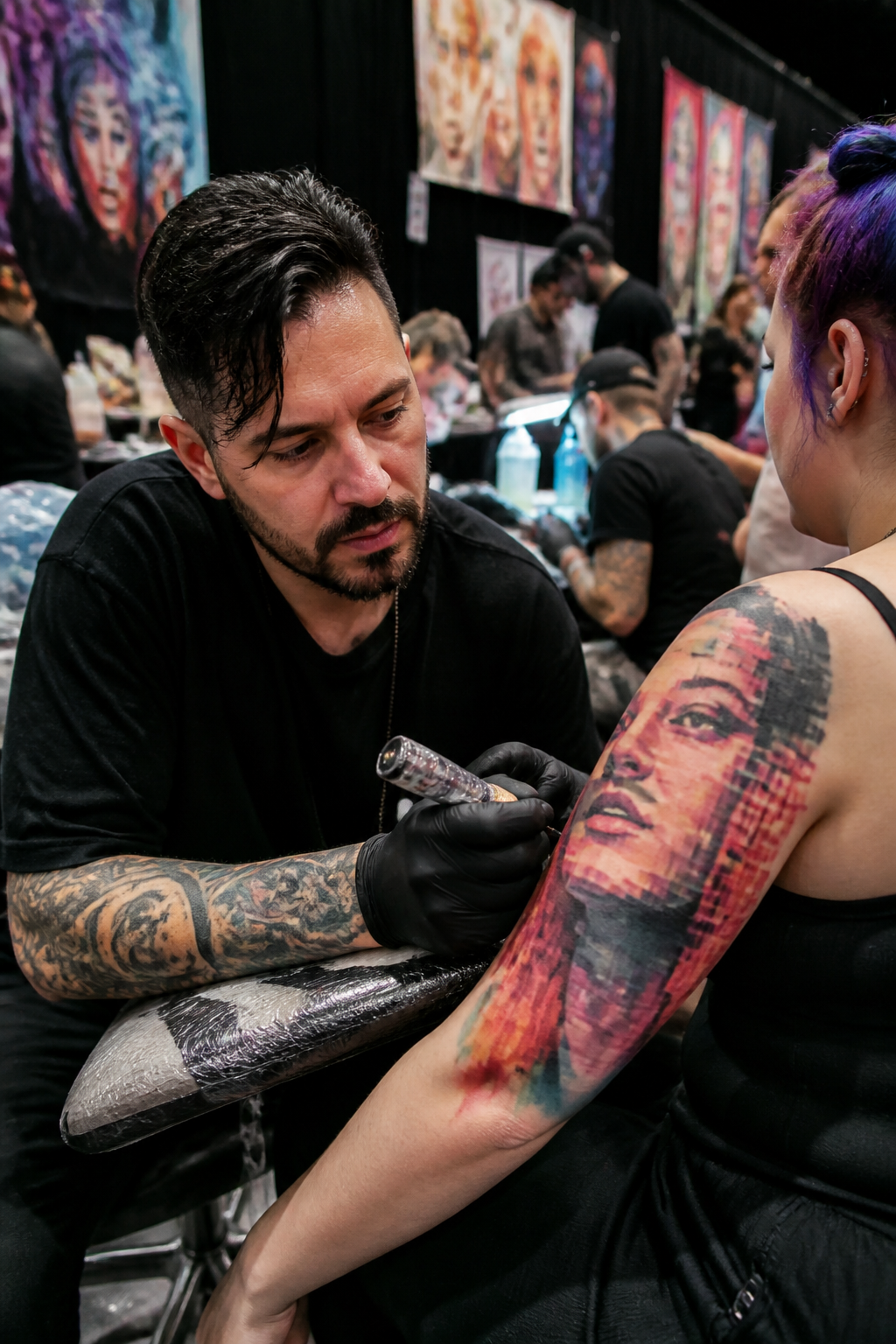
Based in the industrial heart of Berlin, Leo Vargo has quickly become a name to watch in the European tattoo scene. His work, often described as 'Glitch Realism,' blends high-fidelity portraits with digital distortions and static-like textures. By intentionally breaking the anatomy of a design with pixelated offsets, Vargo creates a sense of movement that feels both modern and deeply technical.
His latest project, a full-sleeve composition titled 'Data Decay,' exemplifies this approach. The piece features a hyper-realistic bust of a classic sculpture that appears to be dissolving into a stream of binary code and fractured lines. It is this juxtaposition of the ancient and the digital that has earned him a dedicated following among collectors looking for something beyond traditional portraiture.
Collectors should be aware that Vargo’s process is highly collaborative but restrictive. He rarely takes on pre-drawn concepts, preferring instead to build a custom composition based on a single word or mood provided by the client. This allows him to map the digital 'glitches' to the specific musculature of the body, ensuring the distortion flows naturally with the wearer's movements.
Before reaching out for a booking, it is essential to understand that Vargo works exclusively in high-contrast black and grey. While many realism artists rely on soft shading, Vargo utilizes sharp, staccato needle strokes to mimic digital noise. This technique requires a high pain tolerance, as the layering of textures is more intensive than standard shading methods.
Booking a session at his private studio, The Signal, usually requires a four-month lead time. Potential clients are encouraged to provide clear photos of the intended placement area, as Vargo refuses to work over existing heavy scarring or complex cover-ups that might interfere with the precision of his linework. For those who secure a spot, the result is a piece of wearable art that challenges the boundaries of skin-deep fidelity.